LLM Inflection Points
Simon Willison analyzed three major advancements in large language models and coding agents over a twelve-month span. He discussed these shifts during a keynote address at the AI Engineer Code Summit.
Understanding these technical inflection points helps developers map the trajectory of automated programming tools.
Source posts · 1
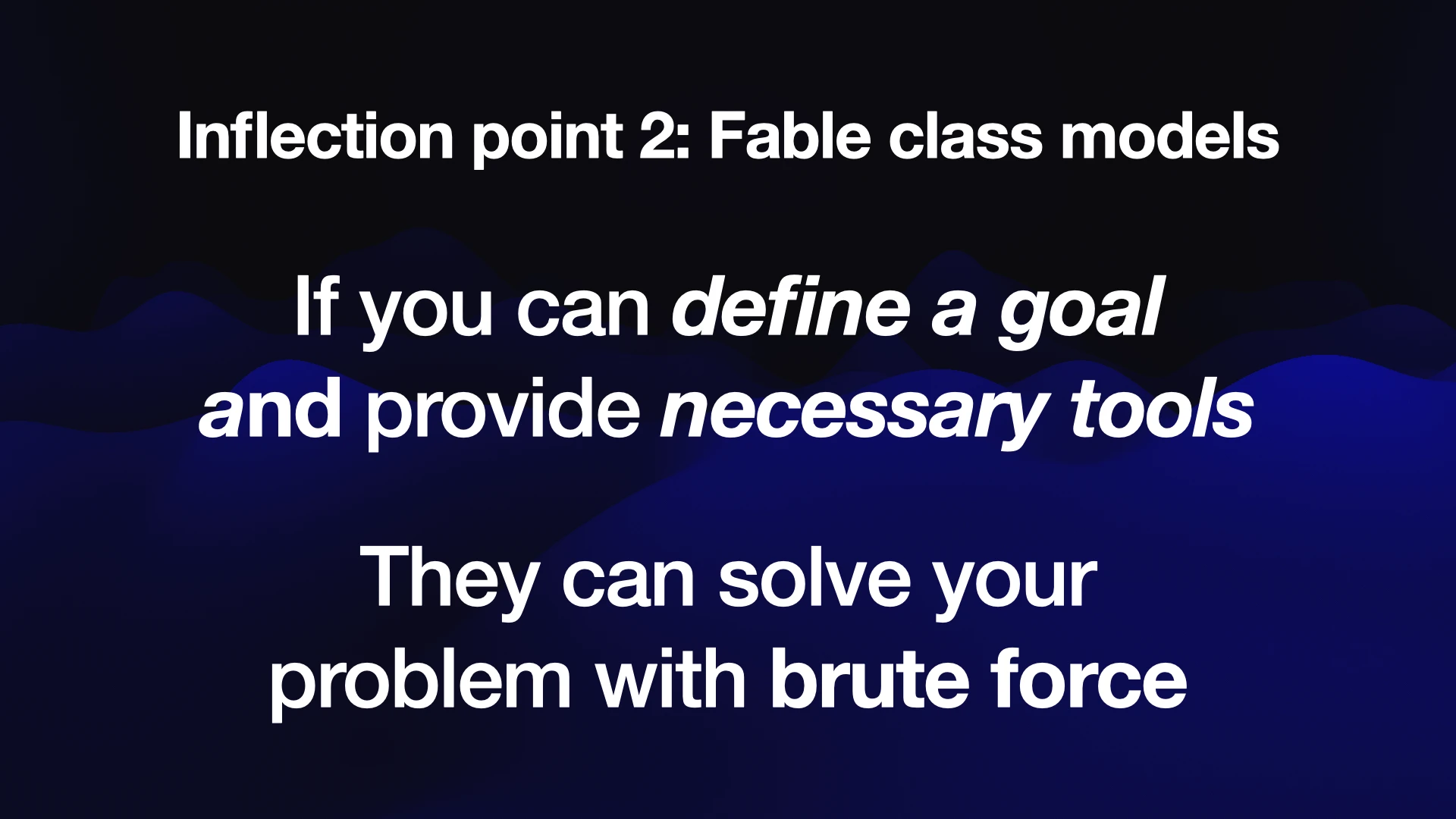
Three LLM inflection points in twelve months — I gave a keynote at the AI Engineer Code Summit a couple of weeks ago, constructed around the idea that there have been three significant inflection points in the abilities of LLMs and coding agents in the past twelve months. Here's the video of the talk. In this post I'm going to pull out the major inflection point theme and interrogate it more deeply. • Coding agents in November 2025 Today, November 24th 2026, is the one year anniversary of the release of Claude Opus 4.5 . With hindsight, this was a consequential model. In the Opus 4.5 announcement, Anthropic said: Testers noted that Claude Opus 4.5 handles ambiguity and reasons about tradeoffs without hand-holding. They told us that, when pointed at a complex, multi-system bug, Opus 4.5 figures out the fix. They said that tasks that were near-impossible for Sonnet 4.5 just a few weeks ago are now within reach. This held up. Claude Code was 9 months old at that point, having been introduced alongside Claude 3.7 Sonnet on February 24th, 2025. Opus 4.5 was the first model I had used with Claude Code where the default result was generally the right thing. I hadn't been using Claude Code as a daily driver because it didn't feel reliable enough - I had to correct it often enough that it didn't feel like a clear accelerant. The new Opus changed that. For most of the coding problems I faced on a daily basis, Opus would get them right . It was clearly faster than working through the problems myself. Also in November, OpenAI released GPT-5.1 Instant, GPT-5.1 Thinking, GPT-5.1-Codex, and GPT-5.1-Codex-Max. These had a similar effect on their Codex coding agent: it became reliably useful for many of my coding tasks. The timing was convenient, because the December holidays were upon us. A lot of people, myself included, spent December tinkering with these new tools to see what they could do. By January we were ready to use them for our actual work. Fable class models in June/July We got our first hint of Claude Fable in April, when Anthropic announced Claude Mythos and said that it was too dangerous to release , due to its improved cybersecurity capabilities. Mythos was a model that could not just find security vulnerabilities, it could also figure out how to exploit them. In June we got to see how good that model was for ourselves, with the release of Claude Fable 5 - a defanged Mythos, that would solve most problems but would actively block you from using it for security work. After three glorious days... the US government took it away from us. Fable 5 was placed under export controls that effectively banned the model. We wouldn't get it back until July 1st. For me, Fable was an inflection point because it introduced us to what I now think of as Fable class models . My definition of these: In June I wrote about how Claude Fable is relentlessly proactive , after I asked it to help fix a display glitch in Safari and it
Simon Willison outlines three major inflection points in LLM and coding agent capabilities over the past twelve months.